Theme Layout

Rightsidebar

Boxed or Wide or Framed

Theme Translation

Display Featured Slider

Yes

Featured Slider Styles

Display Grid Slider

No

Grid Slider Styles

Display Trending Posts

No

Display Author Bio

Display Instagram Footer

Dark or Light Style

Search This Blog

Do you Believe in Dog? (2018). Powered by Blogger.

Copyright Do You Believe in Dog (2018)

The content on Do You Believe in Dog? is copyrighted. If you are interested in using any content produced on Do You Believe in Dog? please email a request.

Strap line

It started when two canine scientists decide to become pen pals in an era of digital media...

Translate

Showing posts with label communication. Show all posts

30 June 2016

Italy: The Fifth Canine Science Forum is Here

Italy: The Fifth Canine Science Forum is Here


Hello world!

It’s Mia and Julie, and we’re at the 5th Canine Science Forum in PADOVA, ITALY!! This is our third canine science forum together. Do You Believe in Dog? started in 2012 when we first met in Barcelona, Spain. Two years later we had a great conference in Lincoln, UK, and now we’re in Italy where the coffee is very, very, very good. We also like the canine science, but really, the coffee is fabulous.


What’s the Canine Science Forum?
You know when you come across a headline, “Study finds dogs do X!!” The Canine Science Forum (CSF) is where researchers behind the headlines come together to share and discuss their latest studies and theories about dogs, wolves and related canines. It’s a place to get a pulse on the field -- what’s going on, and what’s to come.


The CSF is also a reminder that when a headline states, “Study finds X…” that's typically an oversimplification of what was actually found. There's a lot of discussion of the nuances of dog behavior and cognition. And science is complicated, but each study brings to the table a piece of the puzzle that is understanding more about the wonderful (and also, the not so wonderful) dogs in our lives.


The conference consists of short talks, plenary talks, and poster sessions (and important espresso coffee shot breaks). Today we're presenting a poster about Do You Believe in Dog? and the importance of communicating our fields' findings to everyone. The blog will continue to be a space where researchers can share the findings of their research, helping it jump over the paywalls and without the stuffy scientific language, to help dogs everywhere. If you're a researcher and you'd like to know more, check out the contributors page!
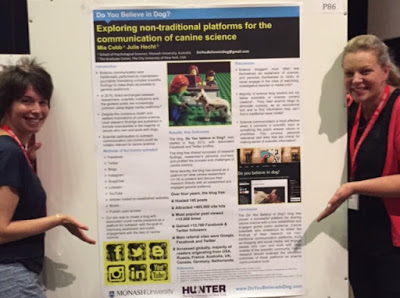

Out poster about Science Communication!
Email if you want a copy: DoYouBelieveInDog @ gmail.com

The conference began earlier this week on Tuesday and concludes tomorrow (here is the entire program). Anyone can follow all conference-based tweets on Twitter at #CSFPadova as well as @DoUBelieveInDog. We of course want to tell you about talk after talk after talk, but space, time, you get the picture... so here are a few highlights:

Doggie brains
Giorgio Vallortigara began the conference looking at brain asymmetry. The dog’s tail offers a pretty nifty insight into the brain — dogs wag more to the right when seeing an owner (associated with left hemisphere activation which is historically associated with approach-type behaviors), whereas seeing a strange person or strange dog prompts more wagging to the left (i.e., right hemisphere activation typically associated with more retreat behavior). Vallortigara also explored why brain symmetry evolved looking at both benefits to the individual as well as on the population level.

Smelly dogs
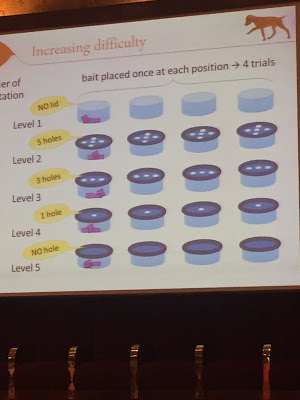
Márta Gácsi did not discuss why dog feet sometimes smell like Fritos (maybe next time, Márta!). Instead, Gácsi and colleagues from the Family Dog Project devised a simple, new procedure — that requires no pre-training — to test Natural detection task olfaction in canids, both hand-raised wolves and dogs.

In the study, they placed food in a plastic box with a lid to control the amount of smell released, and then placed the container under a ceramic pot to avoid visual cues. They wondered whether dogs would attend to the location of the hidden food, even when the access to the food was made increasingly difficult (see picture above). They found this was a good way to identify dogs who were both motivated and good at scent detection. Scent breeds and wolves were generally better at finding the food then non-scent breeds and short-nosed dogs. But hey, on an individual level, a Hungarian greyhound and Whippet (non-scent breeds), scored very very high, as did a Boston terrier (short-nosed dog).

A wider view of dog domestication
Friederike Range of the Clever Dog Lab, Messerli - Research Institute University of Veterinary Medicine Vienna and Wolf Science Center reminded us that as dogs entered the human environment, it wasn't initially because they wanted to spend time with us, cuddle all night long, look into our eyes, and follow our gaze and gestures. Dogs entered the human environment for food and to scavenge and exploit our fabulous resources. She reminds researchers that dogs are adapted to the human environment as scavengers and this should be considered in terms of its consequences for dog behavior. Check out the Open Access article, Tracking the evolutionary origins of dog-human cooperation: the "Canine Cooperation Hypothesis" (Range & Virányi, 2015)   

Oxytocin. Don’t oversimplify me
Love? Affection? Come on, Anna Kis of the Family Dog Project would say. It’s way more complicated than that. Kis won the Early Career Scientist Award, and she discussed how oxytocin is being investigated in terms of human-directed social behaviors in dogs. She covered three main areas of research: measuring peripheral oxytocin levels using blood or urine, exploring single nucleotide polymorphisms in regulatory regions of the oxytocin receptor gene, and administering intranasal oxytocin. Julie covered her research on the oxytocin receptor gene in dogs here.

Stay in touch with the conference this week on Twitter at #CSFPadova

And drink a coffee with us!
Continue Reading »
DoYouBelieveInDog
0 Comments

You Might Also Like

31 August 2014

August lives up to its definition: respected and impressive


The things we noticed in and around canine science over the past two weeks, Storified in one neat location for your convenience:


Further reading:

Feuerbacher E.N. (2014). Shut up and pet me! Domestic dogs (Canis lupus familiaris) prefer petting to vocal praise in concurrent and single-alternative choice procedures, Behavioural Processes, DOI: http://dx.doi.org/10.1016/j.beproc.2014.08.019

Gygax L. (2014). The A to Z of statistics for testing cognitive judgement bias, Animal Behaviour, 95 59-69. DOI: http://dx.doi.org/10.1016/j.anbehav.2014.06.013

Arnott E.R., Claire M. Wade & Paul D. McGreevy (2014). Environmental Factors Associated with Success Rates of Australian Stock Herding Dogs, PLoS ONE, 9 (8) e104457. DOI: http://dx.doi.org/10.1371/journal.pone.0104457


© Do You Believe in Dog? 2014
Continue Reading »
DoYouBelieveInDog
0 Comments

You Might Also Like

20 August 2014

Do You Believe in Dog? A New Ball Game

Do You Believe in Dog? A New Ball Game


Hello Do You Believe in Dog(ers)!

(source)
After two years of mostly pen-pal style blogging, we're excited to share our new direction!

When we first decided to create Do You Believe in Dog?, we committed to blogging back and forth about canine science for two years. We were able to celebrate achieving that goal at the recent 4th Canine Science Forum in Lincoln, UK and also reflect on the future of Do You Believe in Dog?

The DYBID blog, Facebook and Twitter feeds have become vibrant places to access canine science studies and thoughtful commentary. We are pleased and proud of the space we have created and the community who enjoy it. We're as committed as ever to helping people access the canine science conversation, and moving forward, we've decided to open up DYBID as a space where other canine science practitioners can share their findings and thoughts. 

What you can expect

Guest contributors 
Following the format you've enjoyed in earlier guest posts (like Dog training: do you get the timing right?, Take a walk on the wild side: dingo science  and Black dog syndrome, a bad rap?) researchers and students of canine science are welcome to submit short posts to DYBID based on peer-reviewed research. We're hoping posts will focus on research either presented at academic conferences or published in scientific journals. If you have an idea for a post, check out the Contributors page for more details, and be in touch! 

Canine science highlights 
We'll continue our usual presence on Facebook and Twitter, and here on the DYBID blog we'll post fortnightly updates highlighting the canine science that we've been following in the previous two weeks (blog posts, scientific studies, websites, etc.). 

T
his slideshow is our first attempt at sharing Canine science highlights. We have used Storify so you can quickly flip through and click on anything you want more info about.


Where in the world are Mia and Julie?

To simplify our Twitter presence:


Maybe you don't think we've simplified our Twitter presence?!
For us, this is 'simplified' ;)


We'll both be posting things on the DYBID Facebook feed and welcome your continued contributions and conversations there.


We hope you'll enjoy this new direction! We look forward to your feedback as we share canine science highlights and add more voices to the DYBID space.

Thanks again for your support over the past two years -- Now, let's play ball!
(Go Yankees! That was Julie)


Mia & Julie

Further reading:

Dijk E.M.V. (2011). Portraying real science in science communication, Science Education, 95 (6) 1086-1100. DOI: http://dx.doi.org/10.1002/sce.20458


Nosek B.A. (2012). Scientific Communication Is Changing and Scientists Should Lead the Way, Psychological Inquiry, 23 (3) 308-314. DOI: http://dx.doi.org/10.1080/1047840x.2012.717907

Fischhoff B. & Scheufele D. (2013). The science of science communication, Proceedings of the National Academy of Sciences, 110 (Supplement 3) 14033-14039. DOI: http://dx.doi.org/10.1073/pnas.1213273110

(source)

Continue Reading »
DoYouBelieveInDog
0 Comments

You Might Also Like

10 August 2014

Canine Science Forum 2014 - we come full circle!

Canine Science Forum 2014 - we come full circle!


Aw - it's Us @ CSF2014! Thanks Tamás Faragó :)
Dear Julie,


while you've been off enjoying the fjords of Norway and I've been recovering from six legs of long haul flying with a three year old as hand luggage, I thought I'd put up a quick post to recap the wonderful week in Lincoln, UK that was the (Feline and) Canine Science Forum 2014.

Such a fun, stimulating, inspiring week comprising the Feline Science day (Monday), public lecture by James Serpell (rhymes with purple) on Monday evening, Canine Science Forum (Tue-Wed-Thu), including the wonderful gala dinner at Lincoln Castle on Wednesday night and finally, the Companion Animals: Human Health & Disease day (Friday).

If anyone out there happened to miss it, we live tweeted nearly all of the presentations so you can easily catch up on all the great thoughts via the magic of Storify here.


Feline Science Day:

Public lecture by James Serpell:


Canine Science Forum Day 1:


Canine Science Forum Day 2:

Which, of course, included us being real life #scientists (we don't make this stuff up!):


You talked about Project: Play with Your Dog and the role that citizen science can play in canine science.

Nancy Dreschel (now on Twitter at @ndreschel) presented the key findings from our collaborative meta-analysis looking at canine salivary cortisol.


And I explored if using group averages is really the best way to determine and analyse the stress and welfare experience of working dogs (and my points were relevant to all animals!).


Then we drank wine in at a castle. Which was a mighty fine way to end that day.


Canine Science Forum Day 3:


Companion  Animals: Human Health & Disease 2014


We heard the exciting news that the next Canine Science Forum is to be held in Padova, Italy in 2016.

We continued on in England after CSF, down to visit the Animal Welfare and Behaviour Group at Bristol University - it was lovely to share some of our experiences and ideas with this team and we look forward to keeping up with their great work in the future.


And while we took a nap to recover, Do You Believe in Dog? went and turned two years old on us! So here we are - at the end of the original two years that we agreed to do this for, back in that first email exchange not even week after we met. 

120 blog posts with over 170,000 views, 8,900 tweets and over 8,400 followers on Facebook. 

Julie - I don't know how I can ever thank you enough for agreeing to join me on this adventure. I am so proud of how Do You Believe in Dog? has helped bring canine science to everyone. I am equally humbled and thrilled by the community that has grown around our pen pal exchanges - along with the popular guest posts by Clare, Brad, Heather, Christy, Claudia and Lindsay - and feel excited for the future of canine science and its ongoing transfer to the general public. 


Above all Julie, I am so grateful for your beautiful friendship which was perhaps the most fun surprise of this two year journey we have shared. Behind the posts of DYBID? are many email exchanges, Skype calls and messages. Through this media we have developed an incredibly open and honest friendship that I will always cherish. I respect you, your scientific and science communication work enormously. I have learned much from you and look forward to what comes next - for both of us.

"What's that?" you ask?  You'll see!

Mia

Further reading:

Do You Believe in Dog? - all the posts from the last two years!

Hecht, J. and Cooper, C. B. (2014) Tribute to Tinbergen: Public Engagement in Ethology, Ethology, 120 (3) 207-214. DOI: http://dx.doi.org/10.1111/eth.12199

Hecht, J. (2014) Canine Science: a trend you can easily get behind. Dog Spies, Scientific American Blog Network.

Cobb, M. and Hecht, J. (2014) Do You Believe in Dog? An experiment in scientific communication. Canine Science 1 (1) 10-12 DOI: http://dx.doi.org/09.0011/cs.082014

Continue Reading »
DoYouBelieveInDog
0 Comments

You Might Also Like

9 September 2013

Robo-WOOF! What's happening in dog-human communication technology?

Robo-WOOF! What's happening in dog-human communication technology?


(Source)
Hey Julie,
Thank you for the gorgeous congratulations for winning I'm a Scientist, get me out of here! - what an amazing experience! So many students engaged in science and asking questions that made my head spin - fabulous, fabulous stuff! I learned so much!

One of the questions that came up a few times during the live chat sessions with student classes was about communication between dogs and people. I was asked "Do you think dogs will ever be able to talk to humans?" and "Why don't dogs talk? Why do they only bark?", as well as "Do dogs understand us? How?" and "Could we use technology to communicate with dogs?" - you see? They kept me on my toes!

My initial reactions were to say, "Dogs DO talk to us! They use their body language and their vocalisations extremely well, it's just that people aren't always fluent in listening to what they're telling us!" I also told them all about Chaser and her 1,200+ words, about the fact dogs' senses are different to ours (a much less visual, much more sniffy kind of a world).

Then one student said, "But what about this?":

 
Now Julie, I don't know about YOU, but somehow, I missed out on this 'BowLingual' device when it was launched in the early noughties. It's a: 
"computer-based dog-to-human language translation device developed by Japanese toy company Takara and first sold in Japan in 2002. Versions for South Korea and the United States were launched in 2003. The device was named by Time Magazine as a "Best Invention of 2002." The inventors of BowLingual, Keita Satoh, Dr. Matsumi Suzuki and Dr. Norio Kogure were awarded the Ig Nobel Prize for "promoting peace and harmony between the species.
The device is presented as a "translator" but has been called an "emotion analyzer". It is said to use technology to categorize dog barks into one of six standardized emotional categories. BowLingual also provides a phrase which is representative of that emotion. The product instructions clearly state that these phrases "are for entertainment purposes only" and are not meant to be accurate translations of each bark."
I totally endorse all those disclaimers, especially after reading this review by Dr Sophia Yin, but also can't help thinking if this 'toy' device can register a dog's bark and then categorize the dog's mood as happy, sad, on guard, assertive, frustrated or needy - couldn't we just listen and do the same ourselves? I mean, you know that, right? You recently covered the latest scientific findings regarding what dogs' barks are telling us, over at Scientific American and The Bark (ha!).  

So why can't we just listen? Learn? I certainly know the difference between my dogs' barks as to whether there's someone strange approaching our front door versus a family member or if they're just playing when I'm down the other end of our house. I'm teaching my daughter to tell the difference too. She's learning and she's just turned three.  

So is it really that hard? Or are people just lazy?


On the definitely-not-a-toy side of things, a Google Glass researcher has teamed up with a Georgia Institute of Technology professor to create FIDO (Facilitating Interactions for Dogs with Occupations) as wearable technology for working dogs to enable better communication with handlers. 


FIDO works by giving a service or detection dog a special sensor that can attach to its collar of a vest. The dog can interact with the sensor by biting, tugging or touching it with their nose and the handler will receive a corresponding signal ("bomb ahead", "hurricane alarm sounding" or "you have pancreatic cancer" are all examples given for different working dog contexts) as an audio or display cue. You can read more about FIDO in an interview with the professor from Georgia Tech here. 

Then there's the ICPooch, that's currently seeking funding via Kickstarter. The brain child of an entrepreneurial 13 year old (yep, you read that correctly) from the UK, the ICPooch promises to let you video talk with your dog (and deliver a treat cookie!) from anywhere in the world. 

Like this:


What do you think? Gimmick or something that has the potential to actually reduce separation anxiety in dog when their owners are away? Think dogs could potentially be remote trained by professional dog trainers? I wonder how well the dogs can actually SEE the display and whether they would respond differently to different people who 'dial in'. 

Very interested to hear your thoughts on this - hope you're well!

Mia

Further reading:

Tan D., Fitzpatrick G., Gutwin C., Begole B., Kellogg W.A., Paldanius M., Kärkkäinen T., Väänänen-Vainio-Mattila K., Juhlin O. & Häkkilä J. (2011) Communication technology for human-dog interaction: exploration of dog owners' experiences and expectations, Proceedings of the SIGCHI Conference on Human Factors in Computing Systems, 2641. DOI:

Kerepesi A., Jonsson G.K., Miklósi Á., Topál J., Csányi V. & Magnusson M.S. (2005). Detection of temporal patterns in dog–human interaction, Behavioural Processes, 70 (1) 69-79. DOI:

© 2013 Mia Cobb | Do You Believe in Dog?
Continue Reading »
DoYouBelieveInDog
0 Comments

You Might Also Like

12 April 2013

Real Scientists Tweet

Real Scientists Tweet


Hi Julie,

I hope you have an awesome time at Science Online Teen tomorrow! I hope you get asked lots of questions about your presentation, Dogs: Science in Your Living Room. It's so true that dogs make for a sensational gateway to scientific enquiry - and they're right there, in front of us!


If anyone happens to ask you "What's it like being a scientific canine behavioural researcher?", be sure to tell them to tune in to the @realscientists Twitter project from Sunday (or Saturday evening, USA time). 


They can follow you and I for a whole week as we tweet from the @realscientists account, giving insight into our every day activities as canine scientists. 

Will our tweets sound like woofs? (source)
If anyone out there isn't already on Twitter and/or hasn't been following @realscientists, you really should! It's a super fun insight into the world of science, science communication, writers, clinicians and more. Each week features a different flavour of scientific endeavour and I like to think we'll be bringing the real lab science into the spotlight! 

So far, I've seen wild jaguars while canoeing down a river in the Amazon with Phil Torres; learned about mosquito-borne disease management from Cameron Webb and whisked along for the ride of a week in the life of futurist, with Kristin Alford. 


Hypnotised by the eyes (source)
It's so much fun and really important, because some people genuinely believe that scientists look like this and that conducting science looks like this. 

Scary stuff! 

I'm hoping that while we might not be in particularly exotic locations, we can make up for that with our enthusiasm for all things dog and science. Plus, between the two of us, being here in Australia and there New York, we're always here. 

The-blog-that-never-sleeps can now be be the scientists-who-always-tweet!

If anyone out there wants to know how to find out how we spend our week, you can:

(source)
Here's hoping we can drum up some more interesting scientific questions about dogs during the week!

See you in the twittersphere,

Mia

Further reading:
Real Scientists: blog / @realscientists: twitter

Brossard D. & Scheufele D.A. (2012). Social science. Science, new media, and the public., Science (New York, N.Y.), 339 (6115) 40-41. PMID:

Wilcox C.  (2013) Guest Editorial: It's Time To e-Volve: Taking Responsibility for Science Communication in a Digital Age, The Biological Bulletin, 222 (2) 85-87. PMID: 

© 2013 Mia Cobb

Continue Reading »
DoYouBelieveInDog
0 Comments

You Might Also Like

[name=Do You Believe in Dog?] [img=https://blogger.googleusercontent.com/img/b/R29vZ2xl/AVvXsEih0oTdT87wf4V9ic3qh3r4nwYEQ2IsqFtweaU5RXbfIGujIMEg7n7jBmLq88mM9ZWZZ74jemUA2tK0UDNV-mLf4Mx7UzOEv6FISOcaffwhjDIU-9DgKhUj1VILdKBCInozoneqSXX6_kPP/s100/DYBID3+SPARCS2013.jpg] [description=Do You Believe in Dog? is a popular canine science platform presented by Mia Cobb and Julie Hecht. We think it's important that everyone be able to access and understand the latest canine research.] (facebook=https://www.facebook.com/DoYouBelieveInDog/) (twitter=https://www.twitter.com/doubelieveindog/) (instagram=https://www.instagram.com/mlcobb77/) (instagram=https://www.instagram.com/dogspies/)

Follow @SunriseSunsetBlog