Theme Layout

Rightsidebar

Boxed or Wide or Framed

Theme Translation

Display Featured Slider

Yes

Featured Slider Styles

Display Grid Slider

No

Grid Slider Styles

Display Trending Posts

No

Display Author Bio

Display Instagram Footer

Dark or Light Style

Search This Blog

Do you Believe in Dog? (2018). Powered by Blogger.

Copyright Do You Believe in Dog (2018)

The content on Do You Believe in Dog? is copyrighted. If you are interested in using any content produced on Do You Believe in Dog? please email a request.

Strap line

It started when two canine scientists decide to become pen pals in an era of digital media...

Translate

Showing posts with label Play. Show all posts

13 March 2018

Do Dogs Just Want To Have Fun?

Do Dogs Just Want To Have Fun?


Please welcome Rebecca Sommerville, today’s guest contributor. Rebecca joins us to discuss her recent review on the function and welfare of dog play with co-authors Drs. Lucy Asher and Emily O’Connor. 

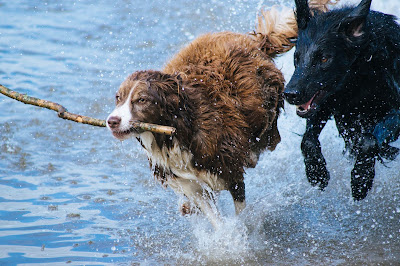
Photo by Jenni Chen, license CC BY

The sight of a dog playing, whether tearing around a park after another dog, or throwing their favourite toy in the air, rarely fails to draw a smile. It seems like dogs just want to have fun. Yet all of that playing uses a lot of energy and puts them at more risk of getting hurt. There must be a good reason they play, but it’s hard to see an obvious one. In the modern world all of their needs should be provided for – food, water, shelter, companionship. So why would dogs do zoomies, if not for fun?

In our recent review paper, we explored research on animal play to help answer this question. Dogs and modern-day wolves share a common ancestor, but during the last 10,000 years, their bodies and minds have been shaped by living with us. They can live harmoniously alongside people and be very attentive to us, and their behaviour is affected by these influences, including play. Our paper looked at the main reasons why animals play and put those reasons to the test with dogs.

The first reason was playing to get stronger, or to develop ‘motor skills’. Dogs play the most when they are young, which suggests that play could strengthen their bones and tissues while they are growing. Many types of movement are seen during play, from fighting to biting, mounting to chasing and manipulating objects – which could all be practice for doing these for real as an adult. However, play is not the best practice, or the best way to get fitter, so it doesn’t make sense why it would exist for this reason alone. It is not the best practice for the muscles and bones because it is sporadic and it doesn’t truly represent the later serious behaviour, only parts of it and in different ways.

The second reason was playing to be prepared, or ‘training for the unexpected’. Play can be quite unpredictable, especially when it is social, and it could prove useful practice for future situations when dogs need to think flexibly and be able to cope. Another interesting aspect is ‘self-handicapping’, where dogs deliberately put themselves at a disadvantage during play, such as to play with a smaller dog. This gives them skills in showing flexible behaviour, for example to signal that they want to back down to avoid a fight if another dog is aggressive towards them, which is particularly important for young dogs to learn. But again, this can’t explain all types of play that dogs do.

The third reason was making friends through play, or ‘social cohesion’. Through play, dogs build their social skills and bonds with others. Dogs prefer to play with someone they know and play can also be used to get to know a new person or dog. There was quite a lot of evidence for this in dogs because the games they play, who they choose to play with, and how they play all revolve around improving their social relationships. 

The final reason was play by accident, or a ‘by-product of biological processes’. As play appears to not have a function, it could be a by-product of something else. For example, play may simply occur because the dog has too much energy, or wants something to do in boring surroundings. It may make up for a lack of contact with other dogs, which is why they play a lot when they meet up with them during walks. Play could also be a learned response, either because it feels good, or because someone taught them to do it, it happens more over time. Through selective breeding, dogs have many qualities of young animals, and play may be one of these. We were not convinced that these are the only reasons play exists though, because there are so many types of play and each dog has their own level of playfulness, which is stable over time.

Unsplash

We also considered what play means for animal welfare. Most people believe that dogs have fun when they play and many scientists think that play is a sign that animals feel healthy and happy. Yet ‘play’ is not one thing. Play can be done alone, with a person, or with other dogs. 

When play is done alone, it is often with a toy or another object. This could improve their physical skills, but be caused by a lack of other stimulation in their surroundings. In some cases tail chasing, that looks like play, can be a sign that something might be wrong.

Play with other dogs is good for welfare as it improves their physical skills, social skills, and coping abilities. However, if play is one-sided, not evenly matched, or turns into aggression (owners aren’t always able to tell the difference), this would not be good for welfare. Some dog breeds are less capable of showing other dogs that they want to be playful, because they have features such as shorter legs, longer bodies, or docked tails. It’s important that dogs have access to other dogs (of various shapes and sizes) from a young age so they can learn how to communicate properly in social situations.

Finally, most dogs prefer to play with their owner than another person. They can play with them as a play partner, or the person can move toys for the dog in a way that acts as a substitute for prey. It’s worth noting that play might not always be fun for the dog if it involves too many commands rather than being spontaneous. There are other ways play between people and dogs could improve dog welfare, such as using play as a way to positively reward training or to improve adoption from shelters by having dog play with prospective owners. Contact with dogs has been shown to make people feel better too! 

Take-aways for dog lovers:
  • There are many types of play and each type builds different skills in a dog.
  • Play is self-rewarding (fun) for dogs.
  • Play is not always a positive sign of a dog’s wellbeing. 
    • Play with other dogs and games with people build their social skills, but take care if play partners are not evenly matched.
    • Excessively playing alone or tail chasing may indicate a lack of stimulation in their surroundings or another problem. 
  • Playing with a dog is good for bonding and consider including play that does not revolve around commands.


Rebecca Sommerville
Animal Welfare Advisor

Reference 
Sommerville, R., O’Connor, E. A., & Asher, L. (2017). Why do dogs play? Function and welfare implications of play in the domestic dog. Applied Animal Behaviour Science, 197, 1-8.

Continue Reading »
DoYouBelieveInDog
1 Comments

You Might Also Like

21 November 2014

Dogtober = Canine science in October


What a BOOMING month for dogs and science October was! We've captured the links to all the latest blogs, research and news that caught out attention throughout Dog-tober.

Thanks to Storify (click here if the you can't see the collection of links below) you can make sure you didn't miss out too.


Further reading:

Bradshaw J.W.S. & Nicola J. Rooney (2014). Why do adult dogs ‘play’?,
Behavioural Processes, DOI: http://dx.doi.org/10.1016/j.beproc.2014.09.023

Bozkurt A., Barbara Sherman, Rita Brugarolas, Sean Mealin, John Majikes, Pu Yang & Robert Loftin (2014). Towards Cyber-Enhanced Working Dogs for Search and Rescue, IEEE Intelligent Systems, 1-1. DOI: http://dx.doi.org/10.1109/mis.2014.77
Continue Reading »
DoYouBelieveInDog
0 Comments

You Might Also Like

9 April 2014

Why do dogs lick people?

Why do dogs lick people?


Just Wow. Photo: Chris Sembrot Photography
Hi Julie,
Yes, but WHY?


I loved Claudia Fugazza's guest post about drawing on dogs' social imitation capacities to learn as copy-cats in the Do as I do training technique. Good stuff!

A few things collided this week that resulted in me deciding to look into why dogs lick people. The first was the Huffington Post 'This Is What Happens When You Ask People To Kiss Their Dogs In Front Of A Camera' (example above from Chris Sembrot's 'For the love of dog' photography collection) that a friend so kindly brought to my attention. 

The second was this tweet that came to us on Twitter from passionate science education guru (and keen admirer of dogs), Charlotte Pezaro:


Now Julie, like me, I'm sure you know there's no quick and easy answer to this - I knew I needed more than 140 characters to respond to Charlotte, and I also threw it out to the 7,500+ people (What! So exciting!) in our Facebook community:

Valid point! Photo: Flickr/jmonin87

Turns out (not surprisingly!) our Facebook community is a really clued in bunch (I've hazed names to be polite). They pretty much know it all anyway. However, for Charlotte's sake, let quickly revisit why indeed, dogs lick us bipedal folk.

Food: the evolutionary basis of licking?
Many people have heard at some point or another that dogs lick at us -- and particularly our faces -- because young wolves lick and poke at adult wolf muzzles to trigger them to regurgitate food that they can then feed on. It's likely that the common ancestor shared by dogs, wolves and other canid species also demonstrated this behaviour, as it's also seen in foxes, African wild dogs, etc. 


However, licking is also seen in young canids (and many mammal species) as a newborn behaviour when a puppy seeks the mother's nipples to feed.

This suckling behaviour is thought to be re-oriented to become a useful pacifying gesture. A human analogy is to consider young children thumb-sucking to self-soothe -- imagine if they licked our faces instead when they felt a bit unsure or stressed! Dogs have been seen to use licking as a type of appeasement behaviour - often interpreted by people as intended to reduce tension or 'apologise'. This kind of 'pacifying' lick can be self directed in the absence of other dogs or people, and in extreme cases, can even be a self-mutilation health issue.

Greeting: I lick you = I like you?
Dogs may lick another (dog, or person) during greeting. This can be for a number of reasons as our clever Facebook team outlined. Greetings can even become ritualised, and in addition to licking, can include play bows, rubbing, jumping, running and vocalising.

These can be considered affiliative behaviours - designed to elicit attachment, often interpreted as bonding and playful. 


Not really from a pirate. 
These greetings are generally consistent and independent of how we look or what we do. Lynette Hart (in The Domestic Dog, see below for reference) suggests that "In this way, dogs may provide their owners with feelings of unconditional acceptance, and at the same time, enhance the person's attachment to the dog". 


Similar to the evolutionary basis of appeasement licking, affiliative licking may have originally developed in young pups experiencing parental licking to keep clean and generalised into a shared bonding and tactile behaviour amongst littermates. 

Others have suggested that dog licking can be used to 'dismiss' people or increase space. This is interesting (outlined here by Dr Patricia McConnell), and although it has not been published in the scientific literature (to my knowledge), it is something I can relate to from scenarios with my own dog. 

 
If I blow in Caleb's face - he will 100%, always, absolutely - lick me. If I do it again, he will 100%, always, absolutely box me with a front paw - usually right in my face. This can be teamed with a play bow and launch into play, he might move his face away or he might leave by walking off altogether. To the left I even managed to interrupt the old man's sleep on the couch to demo this for you (n=1). 


So do you think his lick saying "go away"? Or is it a variation on appeasement? Or affiliative? Food for thought. Speaking of food...

Taste: licks to sample?

Maybe we just taste good? We often have salty, sweaty hands and faces, don't we? We put delicious things into our mouths every day, so why wouldn't dogs be interested in having a sample of the residue? 

We can be fairly sure that licking, in addition to smelling, brings a whole host of information to dogs about where we have been, not just what we've ingested. It also gets our attention which may lead to more interaction, feeding, patting - things that serve to reward the behaviour and reinforce dogs that good things come from licking people.

So Julie - and Charlotte - licking is a lot of things. It can be appeasing and it can be affiliating, it can be exploratory and it can be tasty, it can get our attention or maybe even dismiss us, it can be stress relieving and it can be a sign of anxiety. The initial question asked 'Why do dogs lick you lots when they like us" - but can we assume that because they lick us, they like us? Maybe.
Flickr: MikeBaird
But maybe not always. It's certainly nice to think so. Alexandra Horowitz said, "It is not a stretch to say that the licks are a way to express happiness that you have returned". But then again - it could just be that leg moisturiser you just applied.

What an oxymoron licking appears to be - but it certainly seems important to dogs! 

I think it's important we keep asking these kinds of questions and considering the answers from the dogs' perspective.

Til next time, big slurps to all!


Mia

p.s. maybe 140 characters is enough after all?

Further reading: 

Mech L.D., Wolf P.C. & Packard J.M. (1999). Regurgitative food transfer among wild wolves, Canadian Journal of Zoology, 77 (8) 1192-1195. DOI:


Horowitz, A. (2010). Inside of a dog: What dogs see, smell, and know. Simon and Schuster.

Abrantes, R. (2013). Dog language. Dogwise Publishing.

Serpell, J. (Ed.). (1995). The domestic dog: its evolution, behaviour and interactions with people. Cambridge University Press.


Bradshaw J.W.S., Blackwell E.J. & Casey R.A. (2009). Dominance in domestic dogs—useful construct or bad habit?, Journal of Veterinary Behavior: Clinical Applications and Research, 4 (3) 135-144. DOI:


Bonanni R., Cafazzo S., Valsecchi P. & Natoli E. (2010). Effect of affiliative and agonistic relationships on leadership behaviour in free-ranging dogs, Animal Behaviour, 79 (5) 981-991. DOI:


© Mia Cobb | Do You Believe in Dog? 2014
Continue Reading »
DoYouBelieveInDog
0 Comments

You Might Also Like

15 January 2013

The feeling of play

The feeling of play


(Source)
Hi there Mia,

2013 is looking pretty good! I loved your recent post on motor, sensory and structural aspects of laterality in dogs. This is the type of research that gets me going. Who would think any information could come from this, and then... Tada!!!
Dogs with clockwise chest whorls were more likely 'right-pawed'

Feels like play
Project: Play with Your Dog is going well! We’re getting loads of submissions from people across the globe, and we'll be collecting submissions through Spring 2013. It’s exciting that people are opening up and sharing little tidbits into how they interact with their dogs. 

Bark magazine blogger, JoAnna Lou recently gave the study a shout out, and that has definitely resulted in the submission of more videos!


(Source)
One of the best parts of watching the videos is seeing all the different ways that dogs and people enjoy one another. Play is such a unique exchange, and from one dyad to the next, it can look so different. One reason that play is so varied is that play pulls from so many different cognitive arenas like memory, attention, synchronized behavior and timing. Play between dogs and people can sometimes look so fluid that it’s almost like watching water ballet (not that I watch much water ballet). Some play incorporates routines like tug, chase or fetch, and other players create their own rituals and activities.

The feeling of anticipation
The other thing I love about play is the overarching feelings of excitement, joy and anticipation -- with anticipation probably being my favorite. Play with my cat Josh is mostly about anticipation (And as you know, Josh is behind the world famous Tumblr page, http://thingsmycatbroke.tumblr.com. The page hasn’t been updated in a month, which is probably a good thing). 


(Source)
At various times in the day, Josh will dash into the bedroom, bound onto the bed, and assume his crouching pose that indicates -- It’s play time! Come and get me! When I jump up, he takes off running down the hall. I get a kick out of it, and based on his behavior, I assume he gets a kick out of it too.

In fact, play is often used as an indicator of “positive welfare.” How do we know whether an animal -- or a group of animals -- is doing well, feeling good, and generally happy? How do we explore their welfare? If animals have the time, energy and overall fitness to play, it's often assumed their basic biological functions and physiological needs are met. So a playing animal could indicate that an animal is doing well physiologically and emotionally.

Mia, you’re preparing to speak on the topic of emotional states and working dogs at a really interesting conference organized by
RSPCA Australia: When coping is not enough - Promoting positive welfare states in animals. Do working dogs get time to play? What else will you be talking about? Tell tell!

Happy 2013! Let play (and happiness) reign!


Julie

Reference
Boissy A., Manteuffel G., Jensen M.B., Moe R.O., Spruijt B., Keeling L.J., Winckler C., Forkman B., Dimitrov I. & Langbein J. & (2007). Assessment of positive emotions in animals to improve their welfare, Physiology & Behavior, 92 (3) 375-397. DOI:

© Julie Hecht 2013
Continue Reading »
DoYouBelieveInDog
1 Comments

You Might Also Like

[name=Do You Believe in Dog?] [img=https://blogger.googleusercontent.com/img/b/R29vZ2xl/AVvXsEih0oTdT87wf4V9ic3qh3r4nwYEQ2IsqFtweaU5RXbfIGujIMEg7n7jBmLq88mM9ZWZZ74jemUA2tK0UDNV-mLf4Mx7UzOEv6FISOcaffwhjDIU-9DgKhUj1VILdKBCInozoneqSXX6_kPP/s100/DYBID3+SPARCS2013.jpg] [description=Do You Believe in Dog? is a popular canine science platform presented by Mia Cobb and Julie Hecht. We think it's important that everyone be able to access and understand the latest canine research.] (facebook=https://www.facebook.com/DoYouBelieveInDog/) (twitter=https://www.twitter.com/doubelieveindog/) (instagram=https://www.instagram.com/mlcobb77/) (instagram=https://www.instagram.com/dogspies/)

Follow @SunriseSunsetBlog