Theme Layout

Rightsidebar

Boxed or Wide or Framed

Theme Translation

Display Featured Slider

Yes

Featured Slider Styles

Display Grid Slider

No

Grid Slider Styles

Display Trending Posts

No

Display Author Bio

Display Instagram Footer

Dark or Light Style

Search This Blog

Do you Believe in Dog? (2018). Powered by Blogger.

Copyright Do You Believe in Dog (2018)

The content on Do You Believe in Dog? is copyrighted. If you are interested in using any content produced on Do You Believe in Dog? please email a request.

Strap line

It started when two canine scientists decide to become pen pals in an era of digital media...

Translate

Showing posts with label canine science forum. Show all posts

30 June 2016

Italy: The Fifth Canine Science Forum is Here

Italy: The Fifth Canine Science Forum is Here


Hello world!

It’s Mia and Julie, and we’re at the 5th Canine Science Forum in PADOVA, ITALY!! This is our third canine science forum together. Do You Believe in Dog? started in 2012 when we first met in Barcelona, Spain. Two years later we had a great conference in Lincoln, UK, and now we’re in Italy where the coffee is very, very, very good. We also like the canine science, but really, the coffee is fabulous.


What’s the Canine Science Forum?
You know when you come across a headline, “Study finds dogs do X!!” The Canine Science Forum (CSF) is where researchers behind the headlines come together to share and discuss their latest studies and theories about dogs, wolves and related canines. It’s a place to get a pulse on the field -- what’s going on, and what’s to come.


The CSF is also a reminder that when a headline states, “Study finds X…” that's typically an oversimplification of what was actually found. There's a lot of discussion of the nuances of dog behavior and cognition. And science is complicated, but each study brings to the table a piece of the puzzle that is understanding more about the wonderful (and also, the not so wonderful) dogs in our lives.


The conference consists of short talks, plenary talks, and poster sessions (and important espresso coffee shot breaks). Today we're presenting a poster about Do You Believe in Dog? and the importance of communicating our fields' findings to everyone. The blog will continue to be a space where researchers can share the findings of their research, helping it jump over the paywalls and without the stuffy scientific language, to help dogs everywhere. If you're a researcher and you'd like to know more, check out the contributors page!
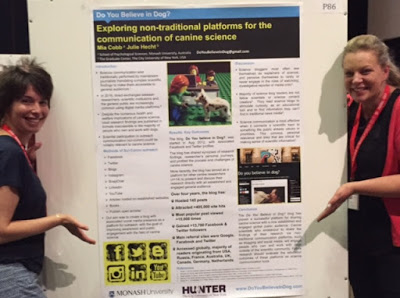

Out poster about Science Communication!
Email if you want a copy: DoYouBelieveInDog @ gmail.com

The conference began earlier this week on Tuesday and concludes tomorrow (here is the entire program). Anyone can follow all conference-based tweets on Twitter at #CSFPadova as well as @DoUBelieveInDog. We of course want to tell you about talk after talk after talk, but space, time, you get the picture... so here are a few highlights:

Doggie brains
Giorgio Vallortigara began the conference looking at brain asymmetry. The dog’s tail offers a pretty nifty insight into the brain — dogs wag more to the right when seeing an owner (associated with left hemisphere activation which is historically associated with approach-type behaviors), whereas seeing a strange person or strange dog prompts more wagging to the left (i.e., right hemisphere activation typically associated with more retreat behavior). Vallortigara also explored why brain symmetry evolved looking at both benefits to the individual as well as on the population level.

Smelly dogs
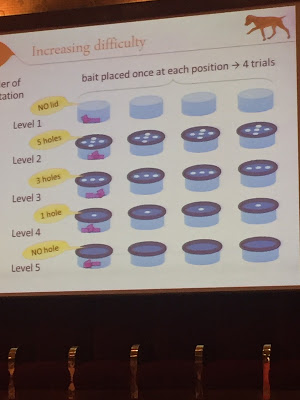
Márta Gácsi did not discuss why dog feet sometimes smell like Fritos (maybe next time, Márta!). Instead, Gácsi and colleagues from the Family Dog Project devised a simple, new procedure — that requires no pre-training — to test Natural detection task olfaction in canids, both hand-raised wolves and dogs.

In the study, they placed food in a plastic box with a lid to control the amount of smell released, and then placed the container under a ceramic pot to avoid visual cues. They wondered whether dogs would attend to the location of the hidden food, even when the access to the food was made increasingly difficult (see picture above). They found this was a good way to identify dogs who were both motivated and good at scent detection. Scent breeds and wolves were generally better at finding the food then non-scent breeds and short-nosed dogs. But hey, on an individual level, a Hungarian greyhound and Whippet (non-scent breeds), scored very very high, as did a Boston terrier (short-nosed dog).

A wider view of dog domestication
Friederike Range of the Clever Dog Lab, Messerli - Research Institute University of Veterinary Medicine Vienna and Wolf Science Center reminded us that as dogs entered the human environment, it wasn't initially because they wanted to spend time with us, cuddle all night long, look into our eyes, and follow our gaze and gestures. Dogs entered the human environment for food and to scavenge and exploit our fabulous resources. She reminds researchers that dogs are adapted to the human environment as scavengers and this should be considered in terms of its consequences for dog behavior. Check out the Open Access article, Tracking the evolutionary origins of dog-human cooperation: the "Canine Cooperation Hypothesis" (Range & Virányi, 2015)   

Oxytocin. Don’t oversimplify me
Love? Affection? Come on, Anna Kis of the Family Dog Project would say. It’s way more complicated than that. Kis won the Early Career Scientist Award, and she discussed how oxytocin is being investigated in terms of human-directed social behaviors in dogs. She covered three main areas of research: measuring peripheral oxytocin levels using blood or urine, exploring single nucleotide polymorphisms in regulatory regions of the oxytocin receptor gene, and administering intranasal oxytocin. Julie covered her research on the oxytocin receptor gene in dogs here.

Stay in touch with the conference this week on Twitter at #CSFPadova

And drink a coffee with us!
Continue Reading »
DoYouBelieveInDog
0 Comments

You Might Also Like

12 March 2014

Canines and Castles: 4th Canine Science Forum Abstract & Early Bird Registration Deadline Friday

Canines and Castles: 4th Canine Science Forum Abstract & Early Bird Registration Deadline Friday


“Two canine scientists, Julie Hecht and Mia Cobb, met briefly at a conference in Barcelona in late July 2012. They share a passion for canine science, good communication, social media and fun.”


So reads the 'About' page at Do You Believe in Dog?. After a brief hello at the 3rd Canine Science Forum in Barcelona, we decided to embark on an adventure as digital pen pals, taking turns blogging on topics related to our own research, that of other research groups and general dog science themes.  

In the last two years, Do You Believe in Dog? has grown to include a blog with over 100 posts, contributions from guest blogging canine scientists around the world, as well as vibrant Facebook and Twitter communities.


Pretty soon, it’ll be time for the 4th Canine Science Forum (Facebook) July 15-17, 2014 in Lincoln, UK! The conference will be proceeded by the 1st Feline Science Forum, July 14, same location, as well as a day dedicated to Companion Animals - Human Health & Disease, July 18, same location (scroll down for the program).

This is a reminder that this Friday, March 14, 2014, is the deadline for abstract submission and early bird conference registration.

The scientific programme includes a number of already scheduled talks. Read about the invited speakers here:

Prof. Benjamin Hart (USA) From the Woods to Home: What Wolves Tell Us About Dog Behavior

Dr. Mariana Bentosela (Argentina)
‘Reinforcement effects upon interspecific communication in domestic dogs. What do we know so far?’

Dr Erik Axelsson (Sweden) ‘What makes the dog special – The canine genome in comparison with other mammalian genomes’

Prof. Clive D. L. Wynne (USA) ‘Comparative Cognition of Dogs and Wolves: What Makes a Dog a Dog?’

Prof. Claudio Sillero (UK) ‘What shapes dog society? Cooperation in the wonderfully adaptable Canidae’

Dr. John Finarelli (Ireland) ‘Patterns and processes from the fossil record of canids’

Prof. James Serpell (USA) Public Lecture


~~

Did we mention the Gala Dinner is in a Castle?

See you at the 4th Canine Science Forum in Lincoln, UK!


Mia and Julie

Check out some of the science presented at CSF2012:

Cobb M., Branson N. & McGreevy P. (2013). Advancing the welfare of Australia’s iconic working dogs, Journal of Veterinary Behavior: Clinical Applications and Research, 8 (4) e42-e43. DOI:

Hecht J. & Horowitz A. (2013). Physical prompts to anthropomorphism of the domestic dog (Canis familiaris), Journal of Veterinary Behavior: Clinical Applications and Research, 8 (4) e30. DOI:

Racca A., Range F., Virányi Z. & Huber L. (2013). Discrimination of familiar human faces in domestic dogs, Journal of Veterinary Behavior: Clinical Applications and Research, 8 (4) e46. DOI:

Dreschel N.A. & Entendencia K. (2013). Stress during certification testing in prison drug detection dogs and their handlers, Journal of Veterinary Behavior: Clinical Applications and Research, 8 (4) e28. DOI:

Howell T.J., Toukhsati S., Conduit R. & Bennett P. (2013). Do dogs use a mirror to find hidden food?, Journal of Veterinary Behavior: Clinical Applications and Research, 8 (6) 425-430. DOI:

All Abstracts can be viewed in the CSF 2012 Conference Handbook
Continue Reading »
DoYouBelieveInDog
0 Comments

You Might Also Like

9 January 2014

2014: A Great Year for Canine Science

2014: A Great Year for Canine Science


Hi Julie,


Hope your festive season was fun and full of laughter. 

Happy new year to you! 

I've decided that 2014 is THE year for canine science! 

It's been a fairly long time since we compared notes on what we're doing at the moment, so I thought I'd start 2014 with a bit of an update for you.


Project finish-the-PhD is GO
It's well and truly time to get this baby fledged! PhD's are not easy at the best of times, and doing mine part time (hello, year seven of working towards this!) has felt a bit like a marathon at times. Luckily, I'm still incredibly excited by my research questions, feeling enthusiastic and looking forward to writing up the results of my research and sharing it with the world. 

source (PhD comics)

My top priorities towards achieving a completed PhD right now are:
  • interpreting the canine salivary cortisol meta-analysis results
  • writing up papers about the perceived welfare of dogs and people's attitudes regarding the importance of various kennel management practices and their relation to canine welfare. Once these are fully drafted (and redrafted x 83), they'll be submitted for publication in a scientific journal

 
Do You Believe in Dog?
It kind of blew my mind when I realised we've been pen-pal-ing here about dogs and science for a year and a half already! 

I'm looking forward to sharing and discussing more of the latest findings in our field with you as 2014 unfolds around us .

I'm also excited to learn more from exciting guest posts by other canine researchers, like Dr Bradley Smith and Clare Browne.

Canine Science Forum
15-17th of July 2014 has already been highlighted in my calendar and hopefully in yours too, Julie! It marks the 4th Canine Science Forum to be held in Lincoln, UK and teamed for the first time with a Feline Science Forum as well. I'm excited about all the new research that will be shared at this conference and also thinking ahead about which aspects of my research I'll be submitting abstracts for in March. I'm intrigued by their call for 'controversies in canine science' presentations - should make for some fun viewing! 


I'm also very much looking to a reunion with YOU - funny to think this blog started on a whim after our very brief encounter at the last CSF.
Human Animal Science
I've been involved in a new science communication project, Human Animal Science. Set up by the Anthrozoology Research Foundation and Anthrozoology Research Group, this podcast series interviews different experts about their research across a wide range of human-animal science topics. 

It's been fun getting the first six episodes recorded - especially the one with you about anthropomorphism - and we've got more interesting people lined up to chat with in 2014.

Working Dog Alliance
Luckily, the Working Dog Alliance is having a quiet few months right now, allowing me to focus on all of the above. The website is a rich resource hub for the Australian working dog industry. Most of the sensational content from the first conference, including the full-of-awesome keynote addresses by Dr Nicola Rooney and Steve White, can be seen/listened to here: http://www.workingdogalliance.com.au/conference2013/ 


Hope you're keeping warm - we've heard it's a very cold Winter in the USA right now. Hard to fathom when our forecast for next week is floating around the 38-40 oC (100-105 oF) mark!

I'd love to hear what you have on the cards for 2014,

Mia
Continue Reading »
DoYouBelieveInDog
0 Comments

You Might Also Like

5 October 2012

Superficial: What do we find attractive? (Part 1)

Superficial: What do we find attractive? (Part 1)


Hi Mia,

Such good eye candy in your last post. I don't know who is cuter, the less fat version of Sampson or the young child he's running with. But I did have a little giggle when watching that live news segment. It's supposed to be all about Sampson's physical appearance yet he's hidden beneath a dog coat, and it's nighttime so he's barely visible. Even when they zoom in, you still can't see anything. Am I making fun of the news program? Hmm maybe it got late, and I got tired.
JLo and her bling

But something I will not make fun of are those comments on your post!! Matt Flavel suggesting it's not necessarily that we are stuffing our dogs silly -- obesity in dogs could have something to do with dogs' gut microbiome. Apparently, data will reveal more and this story is to be continued...

So yes, topics about dogs can be layered and complex, but sometimes we can be superficial about dogs -- even talk bling in dogs.

Bling in dogs
I'm sure you can relate. When I'm walking down the street, I'm constantly checking dogs out. Of course, I'm interested in what they are doing, but other times I'm just looking at the way they look. Sometimes my response is, "YES! YOU LOOK GREAT!! I LIKE YOU!" and other times, the sentiment is more like, "pass." 

Apparently Boo embodies "cute"
At the Horowitz Dog Cognition Lab, we wanted to know what it is about the way dogs look -- their physical appearances -- that we find attractive. This is what I presented at our first meeting at the Canine Science Forum in Barcelona (awww). 

We wanted to exclude from our study any breed preferences as well as the human desire to mush every puppy we see. To do this, and simply focus on the way dogs look, we used images of adult, mixed-breed dogs in our study. 

We explored: are there certain physical attributes that people always prefer when they look at dogs? And is it possible for these preferences to be subconscious and reported through an implicit preference test? Do all people have the same preferences? Or maybe animal people and non-animal people have different preferences. Are big eyes and a large forehead (the infamous "cute factors") always preferred?

So what did we find? Marc Bekoff summarized our findings for Psychology Today in the blog post, Dogs: Looking At the Way We Look At Our Best Friends. 

I will say that our findings are somewhat related to what you were talking about the other day regarding fat -- not phat -- dogs. We found that humans don't always prefer what's in dogs’ best interests. To quote from the Bekoff piece, “While 'animal people' seem drawn to dogs with larger eyes, big eyes can be associated with health issues like brachycephalic ocular syndrome and exposure keratitis. And although participants didn’t implicitly prefer larger nostrils, what if that physical attribute would enhance many dogs' ability to breathe?”


What humans deem aesthetically pleasing in dogs might not always be in dogs' best interests. Frown face...

Night night,

Julie


Referenced

Bekoff, M. Dogs: Looking At the Way We Look At Our Best Friends. Psychology Today. August 21, 2012

Hecht, J. Where should dogs put their tongues? Dog Spies. September 27, 2011

Hecht, J. & Horowitz, A. 2012. Physical prompts to anthropomorphism of the domestic dog (Canis familiaris) Oral presentation at the Third Canine Science Forum, Barcelona, Spain.

© Julie Hecht 2012
Continue Reading »
DoYouBelieveInDog
0 Comments

You Might Also Like

[name=Do You Believe in Dog?] [img=https://blogger.googleusercontent.com/img/b/R29vZ2xl/AVvXsEih0oTdT87wf4V9ic3qh3r4nwYEQ2IsqFtweaU5RXbfIGujIMEg7n7jBmLq88mM9ZWZZ74jemUA2tK0UDNV-mLf4Mx7UzOEv6FISOcaffwhjDIU-9DgKhUj1VILdKBCInozoneqSXX6_kPP/s100/DYBID3+SPARCS2013.jpg] [description=Do You Believe in Dog? is a popular canine science platform presented by Mia Cobb and Julie Hecht. We think it's important that everyone be able to access and understand the latest canine research.] (facebook=https://www.facebook.com/DoYouBelieveInDog/) (twitter=https://www.twitter.com/doubelieveindog/) (instagram=https://www.instagram.com/mlcobb77/) (instagram=https://www.instagram.com/dogspies/)

Follow @SunriseSunsetBlog