Theme Layout

Rightsidebar

Boxed or Wide or Framed

Theme Translation

Display Featured Slider

Yes

Featured Slider Styles

Display Grid Slider

No

Grid Slider Styles

Display Trending Posts

No

Display Author Bio

Display Instagram Footer

Dark or Light Style

Search This Blog

Do you Believe in Dog? (2018). Powered by Blogger.

Copyright Do You Believe in Dog (2018)

The content on Do You Believe in Dog? is copyrighted. If you are interested in using any content produced on Do You Believe in Dog? please email a request.

Strap line

It started when two canine scientists decide to become pen pals in an era of digital media...

Translate

Showing posts with label science. Show all posts

1 November 2018

Women are thriving in canine science - tell a girl you know!

Women are thriving in canine science - tell a girl you know!


When we learned why girls aren't pursuing futures in science, technology, engineering and mathematics, we wanted to help.

At Do You Believe in Dog? we're enthusiastic about canine science for lots of reasons. Clearly - dogs are awesome. So is science! Since starting the blog in 2012, we've noticed that dogs offer a wonderful way to get others interested in science. People who might not have thought it was for them. Canine science is also fantastic because of its inherent diversity. 

Whether you are interested in evolutionary biology, statistics, genetics, human psychology, animal behaviour, wearable tech, nutrition, anatomy, ecology, urban design, communication, biochemistry, exercise physiology, animal-technology interactions, bio-monitoring, science communication or animal learning - canine science offers a way to be involved! 

To showcase how females are thriving in science, we reached out to a selection of the amazing group of woman succeeding in canine-related science, technology, engineering and mathematics (STEM) globally. 

They wanted to help too.

Thanks to their support, we'll be featuring one of these fabulous women each day on our social media channels in November, so be sure to keep track on FacebookTwitterLinkedIn or Instagram.

Here's why we're doing this...

Fewer girls than boys study and work in science, technology, engineering and mathematics (STEM) fields, and the gap between girls and boys is growing. Research into biological factors, including genetics, brain structure and development, neuroscience and hormones, shows that the gender gap in STEM is not the result of sex differences in these factors or related to any type of 'innate ability'. 

When young, girls and boys show the same level of interest and abilities in STEM. They may demonstrate different approaches to solving the same issue - exactly why we need both in these fields as diversity offers strength and flexibility in solving problems. Sadly, social, cultural and educational discrimination and biases are leading to girls losing interest in STEM. The ages between 10-15 have been identified as most critical, with many 15 year olds having already lost interest in STEM subjects. 
Several recent studies have explored this trend across Europe, the US, Canada and Australia, surveying tens of thousands of girls and women.

GIRLS CITED A LACK OF FEMALE ROLE MODELS IN SCIENCE, TECHNOLOGY,  ENGINEERING AND MATHEMATICS AS A KEY REASON THEY DIDN'T FOLLOW A CAREER IN THE SECTOR

  • Having visible female role models almost doubles the number of girls interested in STEM careers and helps them to picture themselves pursuing these fields. 
  • There is a clear link between role models and an increased passion for science, technology, engineering and maths subjects, with more interest in careers in these fields, and greater self-confidence. 
  • Perhaps surprisingly, celebrities are considered to be the least influential role models for driving girls’ interest in STEM, while women working in STEM fields are the top drivers, with the most impact.
  • Increased interest in STEM isn’t limited to a single subject. On average, across maths, physics, biology, chemistry and computer science, having a STEM role model results in a 12 percent increase in interest.
  • Equally as important, results show that if a girl has a role model for a particular subject area, such as maths, a corresponding positive effect is still seen across all other STEM fields.
Girls also become more interested in STEM once they’re able to conceive what they can do with these subjects in real life situations and how relevant they are to their future.

The women in canine science want to help inspire the next generation of girls to know that STEM is accessible, fun and waiting for them. And importantly - SO ARE THE DOGS!

Do You Believe in Dog? are honoured to help share insights to the exciting work in this field and the advice today's women would like to pass on to girls considering a future in STEM. 

So tell a girl you know that females are thriving in canine science. Today, please!

Mia and Julie
Continue Reading »
DoYouBelieveInDog
16 Comments

You Might Also Like

30 June 2016

Italy: The Fifth Canine Science Forum is Here

Italy: The Fifth Canine Science Forum is Here


Hello world!

It’s Mia and Julie, and we’re at the 5th Canine Science Forum in PADOVA, ITALY!! This is our third canine science forum together. Do You Believe in Dog? started in 2012 when we first met in Barcelona, Spain. Two years later we had a great conference in Lincoln, UK, and now we’re in Italy where the coffee is very, very, very good. We also like the canine science, but really, the coffee is fabulous.


What’s the Canine Science Forum?
You know when you come across a headline, “Study finds dogs do X!!” The Canine Science Forum (CSF) is where researchers behind the headlines come together to share and discuss their latest studies and theories about dogs, wolves and related canines. It’s a place to get a pulse on the field -- what’s going on, and what’s to come.


The CSF is also a reminder that when a headline states, “Study finds X…” that's typically an oversimplification of what was actually found. There's a lot of discussion of the nuances of dog behavior and cognition. And science is complicated, but each study brings to the table a piece of the puzzle that is understanding more about the wonderful (and also, the not so wonderful) dogs in our lives.


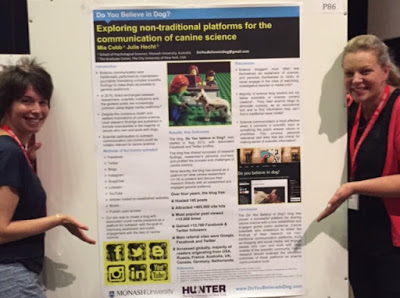
The conference consists of short talks, plenary talks, and poster sessions (and important espresso coffee shot breaks). Today we're presenting a poster about Do You Believe in Dog? and the importance of communicating our fields' findings to everyone. The blog will continue to be a space where researchers can share the findings of their research, helping it jump over the paywalls and without the stuffy scientific language, to help dogs everywhere. If you're a researcher and you'd like to know more, check out the contributors page!


Out poster about Science Communication!
Email if you want a copy: DoYouBelieveInDog @ gmail.com

The conference began earlier this week on Tuesday and concludes tomorrow (here is the entire program). Anyone can follow all conference-based tweets on Twitter at #CSFPadova as well as @DoUBelieveInDog. We of course want to tell you about talk after talk after talk, but space, time, you get the picture... so here are a few highlights:

Doggie brains
Giorgio Vallortigara began the conference looking at brain asymmetry. The dog’s tail offers a pretty nifty insight into the brain — dogs wag more to the right when seeing an owner (associated with left hemisphere activation which is historically associated with approach-type behaviors), whereas seeing a strange person or strange dog prompts more wagging to the left (i.e., right hemisphere activation typically associated with more retreat behavior). Vallortigara also explored why brain symmetry evolved looking at both benefits to the individual as well as on the population level.

Smelly dogs
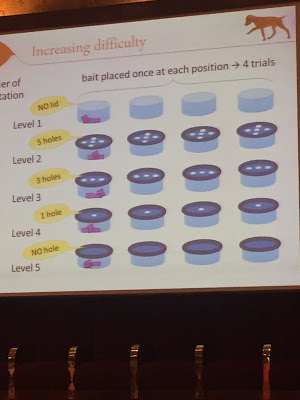
Márta Gácsi did not discuss why dog feet sometimes smell like Fritos (maybe next time, Márta!). Instead, Gácsi and colleagues from the Family Dog Project devised a simple, new procedure — that requires no pre-training — to test Natural detection task olfaction in canids, both hand-raised wolves and dogs.

In the study, they placed food in a plastic box with a lid to control the amount of smell released, and then placed the container under a ceramic pot to avoid visual cues. They wondered whether dogs would attend to the location of the hidden food, even when the access to the food was made increasingly difficult (see picture above). They found this was a good way to identify dogs who were both motivated and good at scent detection. Scent breeds and wolves were generally better at finding the food then non-scent breeds and short-nosed dogs. But hey, on an individual level, a Hungarian greyhound and Whippet (non-scent breeds), scored very very high, as did a Boston terrier (short-nosed dog).

A wider view of dog domestication
Friederike Range of the Clever Dog Lab, Messerli - Research Institute University of Veterinary Medicine Vienna and Wolf Science Center reminded us that as dogs entered the human environment, it wasn't initially because they wanted to spend time with us, cuddle all night long, look into our eyes, and follow our gaze and gestures. Dogs entered the human environment for food and to scavenge and exploit our fabulous resources. She reminds researchers that dogs are adapted to the human environment as scavengers and this should be considered in terms of its consequences for dog behavior. Check out the Open Access article, Tracking the evolutionary origins of dog-human cooperation: the "Canine Cooperation Hypothesis" (Range & Virányi, 2015)   

Oxytocin. Don’t oversimplify me
Love? Affection? Come on, Anna Kis of the Family Dog Project would say. It’s way more complicated than that. Kis won the Early Career Scientist Award, and she discussed how oxytocin is being investigated in terms of human-directed social behaviors in dogs. She covered three main areas of research: measuring peripheral oxytocin levels using blood or urine, exploring single nucleotide polymorphisms in regulatory regions of the oxytocin receptor gene, and administering intranasal oxytocin. Julie covered her research on the oxytocin receptor gene in dogs here.

Stay in touch with the conference this week on Twitter at #CSFPadova

And drink a coffee with us!
Continue Reading »
DoYouBelieveInDog
0 Comments

You Might Also Like

17 May 2016

What happens to your heart when you share time with dogs?   #HeartsAligned

What happens to your heart when you share time with dogs? #HeartsAligned


Most dog owners will tell you that their dogs are good for them. They don't need a scientist to tell them that. But if you ask those same owners "How is your dog good for you?", they might struggle to find the words to describe what underlies the feelings they have about their animal companions.

I recently helped out with a demonstration (organised by Pedigree) that measured the heart rates of dogs and their owners, while separated and when reunited. The idea was prompted by an observation made by Dr Rollin McCraty, who monitored his son and their dog. We used non-invasive heart rate monitors on three dogs and their owners, to measure their heart rate rhythms in real time. We set the owner up on a couch, in front of cameras and lights in a studio, and kept their dog on the other side of a screen, out of sight, for less than two minutes. We then reunited the dogs and owners and encouraged the owner to relax with their dog on the couch, as they would usually do at home. The results? Well - see for yourself, here:


If you had asked me before the demonstration, what to expect, I would have told you "a reduction in heart rates for both dogs and owners over time (maybe 3-5min or so), perhaps after an slight initial increase of reunion excitement". I would not have predicted the close coherence in patterns that we observed within 1min of the reunion. Even as a dog owner and canine science researcher, who knows my dog helps me lead a healthier, happier life, I was astonished!

I genuinely hope this phenomenon is an area of human-animal interaction that attracts more research attention.

So how do dogs help our health?
It's currently unclear what processes underlie the coherence of heart rate patterns we observed between dogs and their owners during the Hearts Aligned demonstration. It's fascinating and something I'd love to research further. Although this was a small case study of just three dogs, the results were striking. 

These Australian dogs and their owners were randomly recruited through a routine casting call to the general public. The data are authentic. It was a delight to witness the beautiful relationship that Glenn, Alice and Sienna enjoyed with their dogs, Lyric, Juno and Jake. It would be interesting to explore the closeness of pattern alignment with other validated measures such as attachment (a term used in psychology that describes the strength of the emotional bond) between people and their dogs.


Glenn & Lyric, Alice & Juno, Sienna & Jake
Existing research suggests that pet owners exercise more, which of course is beneficial for our health. Pets have also been shown to improve cardiovascular health in other ways. For example, patting your dog can release oxytocin that acts to reduce levels of stress hormones, resulting in  lower blood pressure and heart rate. Additionally, research shows us that heart attack survivors and people with serious heart related abnormalities who own dogs may live longer than people with the same problems who don't have pets. There are also many studies suggesting animal companions are good for boosting our social resilience and mental health too.

The Hearts Aligned demonstration shows us that perhaps something as simple as relaxing in the company of our dogs at the end of a day of work or school, might also help to reduce our heart rate and offer our bodies a break from the stresses of everyday life.

Speaking for myself, I feel more light-hearted when in the company of my dog. He distracts me from every day stresses, promotes me to get outside and exercise, makes me laugh every day with his antics and gives me company, even when other family members are away. I think I'm a fairly typical dog owner and that others share these feelings. Physically, these things probably result in a lower heart rate and blood pressure than I'd otherwise experience, and I suspect I feel less stressed than I otherwise would.

Luckily, I was able to enjoy the relaxing effect of patting the beautiful Millie when I was invited onto the Studio 10 program to talk about how dogs can help us stress less on national TV:


Hearts Aligned is also fundraising for the national rescue organisation, Pet Rescue, who support over 950 shelters across Australia. We hope the video inspires people to share their own dog photos using the official hashtag #HeartsAligned. Each post on Facebook will trigger a $1 donation from Pedigree to Pet Rescue, up to $20,000. 

That's certainly enough evidence to make my heart feel good!

Mia

Further reading:
Cutt, HE, Knuiman, MW, Giles-Corti, B, 2008, ‘Does getting a dog increase recreational walking?’, International Journal of Behavioral Nutrition and Physical Activity, vol. 5. pp. 17-27.

McConnell, AR, Brown, CM, Shoda, TM, Stayton, LE, Martin, CE, 2011, ‘Friends with benefits: on the positive consequences of pet ownership’, Journal of Personality & Social Psychology, vol.101, no.6, pp.1239-1252

Headey, B, Na, F, Grabka, M, & Zheung, R, ‘Pets and human health in Australia, China and Germany: Evidence from three continents’, 2004, International Association of Human Animal Interaction Organisations Conference, Glasgow.

Nagengast, SL, Baun, MM, Megel, M, and Leibowitz, JM, 1997,‘The effects of the presence of a companion animal on physiological arousal and behavioural distress in children, Journal of Pediatric Nursing, vol. 12, pp. 323-330.

Thompson, KL, & Gullone, E, ‘Prosocial and Antisocial Behaviours in Adolescents: An Investigation into Associations with Attachment and Empathy’, Anthrozoos, vol.21, no. 2, pp. 123-137.

Wood L, Martin K, Christian H, Nathan A, Lauritsen C, Houghton S, et al. (2015) The Pet Factor - Companion Animals as a Conduit for Getting to Know People, Friendship Formation and Social Support. PLoS ONE 10(4): e0122085. doi:10.1371/ journal.pone.0122085

© Mia Cobb || Do You Believe in Dog? 2016
Continue Reading »
DoYouBelieveInDog
0 Comments

You Might Also Like

13 October 2015

What can a DNA test tell you about your mixed breed dog?

What can a DNA test tell you about your mixed breed dog?


The results are IN!
Rudy's DNA test results have come back.


Let's see what a DNA test can tell us about this mixed breed dog.

What you thought he was

We asked you all to place your bets on what mix of breeds he might contains, and boy did you come to the party! Here's what the poll results say YOU think he is:


The 'Other' category included suggestions of: Collie, English Foxhound, Irish Setter, Galgo, Super cute curly tail hound (!), Glamour dog(!), Borzoi, Petit Basset Griffon Vendeen, Pomeranian and German Shepherd.


What the DNA test says he is

Not surprisingly, Rudy has been identified as having come from a line of mixed breed dogs. 

We know that he was picked up as a stray in a very rural/bush area as a four month old puppy. In that location, it's likely he was bred to be a hunting dog, and was bred from a line of dogs very similar to him. Both of Rudy's parent have been identified as being mixed breeds. This has meant the DNA test is not just a clear cut simple cross between two breeds, but a bit murkier to decipher. 

What we expected

We always knew there would be sighthound in the mix! Fortunately, one grandparent on each side (e.g. his mother's mother and his father's father) have been identified as being a single breed. So the test says that Rudy is identified as one-quarter Scottish Deerhound and one-quarter Greyhound. This makes sense and fits with his physical appearance.


(Photo: source)
(Photo: Sue Muir)

Part of Rudy's DNA test results report


What we weren't expecting

Because of Rudy's muddled up mixed breed lineage, the DNA test results offer us a further five breeds that have been identified as "the 5 next best breed matches which appeared in the analysis of your dog's DNA. One or more of these breeds could have contributed to the genetic makeup of the ancestors indicated by the mixed breed icon. The breeds are listed by the relative strength of each result in our analysis with the most likely at the top of the list". This is definitely where the fun starts!

*Drumroll*

With the highest 'relative strength' (undefined and unclear if this is supposed to be % of total dog, or % of the 50% unaccounted for, or some other strength) of 10.86 (again, 10.86 units of what, or out to a total available number of ##, is unclear) - is... 

The Dobermann! I find this plausible. Dobermanns are certainly not unusual in Australia and I can see inclusion in a line of hunting-purpose dogs making sense to someone at some point, way back when. Rudy also has a wonderful mate who's a Dobe, so now they're totes cousins.


Dobermann reportedly represented in Rudy with strength of 10.86
Now, our first surprise... coming in with strength of 10.55 - the Shetland Sheepdog! Ha! I would have been more convinced by a Rough Collie I think, but who knows, maybe Rudy's great great grandma was a house dog sheltie? It would explain those neck flares... This is nothing compared to the next couple!


Shetland sheepdog reportedly in Rudy with a strength of 10.55

Oh hi there Puli, with a strength of 6.64. In a million blue moons, I would never have picked you in this line up! There are not that many Puli breeders in Australia, and to think that one was used to contribute to a farmer's hunting line seems... odd. But then, my personal favourite is still to come....

Puli reportedly in Rudy with strength of 6.64

...but we'll save it for last. Coming in with the second lowest strength of the five mixed breed contributors identified, we have the Irish Wolfhound. I know most of you thought this was going to be a leading contributor to Rudy's make up, but whatever strength represents, 3.28 doesn't seem like much of it. So now my favourite....

Irish Wolfhound identified in Rudy with a strength of 3.28

Basset Hound. I guess Rudy gets his leg from the other side of the family, right?! With a strength of 1.63, it's the final and lowest reported strength identified in Rudy's report.

Basset Hound reportedly in Rudy with a strength of 1.63

Part of Rudy's DNA test results report


The science behind mixed breed DNA tests

So how did the results end up like this? DNA tests for mixed breed dogs vary between providers. We used the Australian Advance/Waltham test which is 'powered by Wisdom Panel', validated against Australian dog populations. This test examines the 321 markers from the DNA against a database of DNA markers for over 200 representative (NB: not comprehensive!) breeds of dogs and a computer program evaluates and returns a probable 'pedigree tree' reaching back three generations. Every possible combination the computer program arrives at is scored and the tree with the highest score is deemed most probable and presented in the report.

An important note about this kind of test is that 321 markers are not that many. Other canine research (genotyping for whole genome analysis) can use 170,000 markers. Human ethinicity testing relies on 20,000 (to determine caucasian/non-caucasian) -700,000 markers. 

321 markers provide a reduced scope of DNA marker testing, and they are comparing an unknown dog against a bank of typical groups of alleles that representatives for breeds, so the robustness of the test results should definitely be considered as a suggestion, more than an absolute truth. 

Another way to think of it

The best analogy (that may be over simplified, but I think is still useful) that I have been able to come up with to help explain this test in relation to mixed breed dogs is to think of dogs as colours. 

By this, I mean there is a broad spectrum and range, all able to be mixed together in various combinations, over time. We've applied some values to the range (such as when blue becomes green, or orange moves into red) which we can think of as breeds. 

Image: Dean Russo
So consider Rudy as being a light brown colour. The DNA test is essentially trying to determine the combination of colours that arrived at that shade of light brown. It's pretty sure there's some red and green in there, perhaps some yellow too. But because he's such a mixed up colour, it's harder to work out if there's also been orange  (or was it a certain shade of red with a different shade of yellow?), white, a darker brown or even some bright blue included, and when they might have been mixed into him. 

The computer program has presented his report with one possible combination of colours that arrived at his shade of light brown, but it's not the only possible combination to get there. And when I consider where he came from and the likely uses and sources of his forebears, I can be fairly sceptical about some of the results (I'm looking at YOU mop dog!).

For example, I would probably have believed fox hound over basset hound. Or rough collie over sheltie, and I'm not confident how well 321 markers can discriminate between low levels of these breeds in comparison to each other by using the database of 'typical representatives'. As time goes by and the databases are expanded, these tests become more reliable. For example, the test conducted this year is likely more correct than one done five years ago. If they extend the number of markers examined to 1,000 in the future, this would improve the accuracy again.

So - what is Rudy?


He is our dog. Much-loved family member, silly goose, and constant source of delight to our family. His breed heritage is not so important to us. We knew he was sighthound mix type of dog when we adopted him, and he still is. When I next get asked (as I always do!) "What IS HE?", I can now reply with a slightly more informed "He's a mix, mostly deerhound and greyhound, with little bits of a few other things in there too". He is certainly a dog.

Look forward to any comments and questions you might have,

Mia

Further reading:

van Rooy, D., Arnott, E. R., Early, J. B., McGreevy, P., & Wade, C. M. (2014). Holding back the genes: limitations of research into canine behavioural geneticsCanine Genetics and Epidemiology1(1), 7.

Hedrick, P. W., & Andersson, L. (2011). Are dogs genetically special?.Heredity106(5), 712.

McPhee, C. G. (2011). Advances in canine genetic testing—And what these tests mean for youVeterinary Medicine106(12), 608.

© 2015 Mia Cobb | Do You Believe in Dog?

Continue Reading »
DoYouBelieveInDog
3 Comments

You Might Also Like

[name=Do You Believe in Dog?] [img=https://blogger.googleusercontent.com/img/b/R29vZ2xl/AVvXsEih0oTdT87wf4V9ic3qh3r4nwYEQ2IsqFtweaU5RXbfIGujIMEg7n7jBmLq88mM9ZWZZ74jemUA2tK0UDNV-mLf4Mx7UzOEv6FISOcaffwhjDIU-9DgKhUj1VILdKBCInozoneqSXX6_kPP/s100/DYBID3+SPARCS2013.jpg] [description=Do You Believe in Dog? is a popular canine science platform presented by Mia Cobb and Julie Hecht. We think it's important that everyone be able to access and understand the latest canine research.] (facebook=https://www.facebook.com/DoYouBelieveInDog/) (twitter=https://www.twitter.com/doubelieveindog/) (instagram=https://www.instagram.com/mlcobb77/) (instagram=https://www.instagram.com/dogspies/)

Follow @SunriseSunsetBlog