Theme Layout

Rightsidebar

Boxed or Wide or Framed

Theme Translation

Display Featured Slider

Yes

Featured Slider Styles

Display Grid Slider

No

Grid Slider Styles

Display Trending Posts

No

Display Author Bio

Display Instagram Footer

Dark or Light Style

Search This Blog

Do you Believe in Dog? (2018). Powered by Blogger.

Copyright Do You Believe in Dog (2018)

The content on Do You Believe in Dog? is copyrighted. If you are interested in using any content produced on Do You Believe in Dog? please email a request.

Strap line

It started when two canine scientists decide to become pen pals in an era of digital media...

Translate

Showing posts with label welfare. Show all posts

30 May 2018

Free canine science event, June 1-3: Live streaming world wide! #SPARCS18

Free canine science event, June 1-3: Live streaming world wide! #SPARCS18


It’s Baaack! 

You may remember us talking about the SPARCS conference in 2013, 2014, and 2015. After a 2-year hiatus, it’s baaack! And people who care about dogs all around the world are pretty much losing it with excitement (like on the SPARCS Facebook page!).

SPARCS, which stands for the Society for the Promotion of Applied Research in Canine Science, has been at the forefront of connecting dog lovers to canine science via a free, live streaming conference that actively brings dog people into the conversation #SPARCS18! 

SPARCS returns for 2018, this Friday, Saturday and Sunday, June 1 - 3. This time, it’s all about what’s underneath: canine behavioral genetics. Six canine researchers, behavioral veterinarians, and geneticists bring us ‘The Real Dog: What We Know & What We Don’t (Yet).’

#SPARCS18 speakers and science hosts!
We’re incredibly excited to join SPARCS for the third year as science hosts. The conferences is live streaming from New York's Hudson Valley (EDT), and is now presented by The National Canine Research Council. As we prepare for the conference, here’s what you should know about watching and engaging live, and even how to watch later.


June 1 - 3, 2018
9:30am - 5:15pm (EDT)
Each day features two speakers, post-talk Q&A, and an end-of-day group panel discussion 4:30pm - 5:15pm

Friday, June 1
Ádám Miklósi and Kristopher Irizarry kick us off with the evolution of dogs’ close relationship with humans.


Saturday, June 2
Claire Wade and Elinor Karlsson introduce the amazingly complex relationship between genomics and behavior, which in recent years has been clarified with the help of citizen science.


Sunday, June 3
Kelly Ballantyne and Jessica Hekman wrap it up and get really real about the impact of behavioral genetics on dog relationships with humans and the important recognition that genetics don’t necessarily mean predestination.


Get social: Pose questions and comments for speaker Q&As and daily panel discussions. This live streaming conference is anything but passive — unless that’s what you want, in which case sit back in your pajamas and relax! After each talk, we (Mia and Julie of Do You Believe in Dog?) will hold speaker Q&A sessions, and our questions (we hope!) will be your questions! 

Share questions or comments over Twitter DYBID using #SPARCS18, and feel free to post on the Do You Believe in Dog Facebook page too. Remember, SPARCS is also on Facebook and Twitter

Watch later: All presentations and panel discussions will be recorded and posted to the SPARCS website following the conference. 

Watch the past: As mentioned, this is the 4th SPARCS conference, and past presentations, speaker interviews, and panel discussions are available, right now, for free, on the SPARCS website. Hear from Marc Bekoff, Michael Fox, Clive Wynne, Ádám Miklósi, Ray Coppinger, James Serpell, Simon Gadbois, Monique Udell, Alexandra Horowitz, Kathryn Lord, Patricia McConnell, Stephen Zawistowski, Michael Hennessey, Bonne Beerda, James Ha, Hal Herzog, Márta Gácsi and others anytime you like. 
Continue Reading »
DoYouBelieveInDog
0 Comments

You Might Also Like

13 March 2018

Do Dogs Just Want To Have Fun?

Do Dogs Just Want To Have Fun?


Please welcome Rebecca Sommerville, today’s guest contributor. Rebecca joins us to discuss her recent review on the function and welfare of dog play with co-authors Drs. Lucy Asher and Emily O’Connor. 

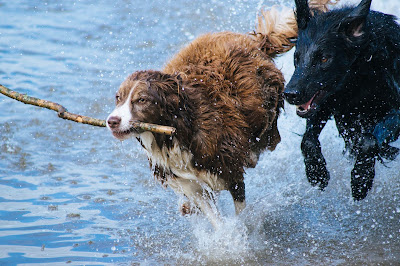
Photo by Jenni Chen, license CC BY

The sight of a dog playing, whether tearing around a park after another dog, or throwing their favourite toy in the air, rarely fails to draw a smile. It seems like dogs just want to have fun. Yet all of that playing uses a lot of energy and puts them at more risk of getting hurt. There must be a good reason they play, but it’s hard to see an obvious one. In the modern world all of their needs should be provided for – food, water, shelter, companionship. So why would dogs do zoomies, if not for fun?

In our recent review paper, we explored research on animal play to help answer this question. Dogs and modern-day wolves share a common ancestor, but during the last 10,000 years, their bodies and minds have been shaped by living with us. They can live harmoniously alongside people and be very attentive to us, and their behaviour is affected by these influences, including play. Our paper looked at the main reasons why animals play and put those reasons to the test with dogs.

The first reason was playing to get stronger, or to develop ‘motor skills’. Dogs play the most when they are young, which suggests that play could strengthen their bones and tissues while they are growing. Many types of movement are seen during play, from fighting to biting, mounting to chasing and manipulating objects – which could all be practice for doing these for real as an adult. However, play is not the best practice, or the best way to get fitter, so it doesn’t make sense why it would exist for this reason alone. It is not the best practice for the muscles and bones because it is sporadic and it doesn’t truly represent the later serious behaviour, only parts of it and in different ways.

The second reason was playing to be prepared, or ‘training for the unexpected’. Play can be quite unpredictable, especially when it is social, and it could prove useful practice for future situations when dogs need to think flexibly and be able to cope. Another interesting aspect is ‘self-handicapping’, where dogs deliberately put themselves at a disadvantage during play, such as to play with a smaller dog. This gives them skills in showing flexible behaviour, for example to signal that they want to back down to avoid a fight if another dog is aggressive towards them, which is particularly important for young dogs to learn. But again, this can’t explain all types of play that dogs do.

The third reason was making friends through play, or ‘social cohesion’. Through play, dogs build their social skills and bonds with others. Dogs prefer to play with someone they know and play can also be used to get to know a new person or dog. There was quite a lot of evidence for this in dogs because the games they play, who they choose to play with, and how they play all revolve around improving their social relationships. 

The final reason was play by accident, or a ‘by-product of biological processes’. As play appears to not have a function, it could be a by-product of something else. For example, play may simply occur because the dog has too much energy, or wants something to do in boring surroundings. It may make up for a lack of contact with other dogs, which is why they play a lot when they meet up with them during walks. Play could also be a learned response, either because it feels good, or because someone taught them to do it, it happens more over time. Through selective breeding, dogs have many qualities of young animals, and play may be one of these. We were not convinced that these are the only reasons play exists though, because there are so many types of play and each dog has their own level of playfulness, which is stable over time.

Unsplash

We also considered what play means for animal welfare. Most people believe that dogs have fun when they play and many scientists think that play is a sign that animals feel healthy and happy. Yet ‘play’ is not one thing. Play can be done alone, with a person, or with other dogs. 

When play is done alone, it is often with a toy or another object. This could improve their physical skills, but be caused by a lack of other stimulation in their surroundings. In some cases tail chasing, that looks like play, can be a sign that something might be wrong.

Play with other dogs is good for welfare as it improves their physical skills, social skills, and coping abilities. However, if play is one-sided, not evenly matched, or turns into aggression (owners aren’t always able to tell the difference), this would not be good for welfare. Some dog breeds are less capable of showing other dogs that they want to be playful, because they have features such as shorter legs, longer bodies, or docked tails. It’s important that dogs have access to other dogs (of various shapes and sizes) from a young age so they can learn how to communicate properly in social situations.

Finally, most dogs prefer to play with their owner than another person. They can play with them as a play partner, or the person can move toys for the dog in a way that acts as a substitute for prey. It’s worth noting that play might not always be fun for the dog if it involves too many commands rather than being spontaneous. There are other ways play between people and dogs could improve dog welfare, such as using play as a way to positively reward training or to improve adoption from shelters by having dog play with prospective owners. Contact with dogs has been shown to make people feel better too! 

Take-aways for dog lovers:
  • There are many types of play and each type builds different skills in a dog.
  • Play is self-rewarding (fun) for dogs.
  • Play is not always a positive sign of a dog’s wellbeing. 
    • Play with other dogs and games with people build their social skills, but take care if play partners are not evenly matched.
    • Excessively playing alone or tail chasing may indicate a lack of stimulation in their surroundings or another problem. 
  • Playing with a dog is good for bonding and consider including play that does not revolve around commands.


Rebecca Sommerville
Animal Welfare Advisor

Reference 
Sommerville, R., O’Connor, E. A., & Asher, L. (2017). Why do dogs play? Function and welfare implications of play in the domestic dog. Applied Animal Behaviour Science, 197, 1-8.

Continue Reading »
DoYouBelieveInDog
1 Comments

You Might Also Like

8 July 2015

Getting practical: Do non-experts make the same behavior assessments of working dogs as experts?

Getting practical: Do non-experts make the same behavior assessments of working dogs as experts?


Guest post by: Jamie Fratkin, PhD

First off, I just wanted to say that I love reading your blog! ('THANK You!' say Mia and Julie). I think it’s such a great platform to deliver the latest in dog research for both researchers and dog lovers, and I am excited to be able to contribute. 

Dog being dog. Copyright Steve DeBono.
Just as a bit of background on me. I just finished my PhD in Social/Personality Psychology at the University of Texas at Austin, working with Sam Gosling. My research focus has been examining personality in dogs as well as examining relationships between dogs and people. The project I’ll be talking about is one that I started in my first year of grad school.

The idea for the project was prompted by a practical question in the context of working dogs. Numbers vary a bit depending on the organization, but only about 50% of the dogs trained and bred for working-dog roles end up succeeding or actually working in the roles they were bred for. Lots of money and time is spent raising and training these dogs and with so few dogs succeeding, it is important to determine the factors that might influence success. If we can find these factors we may be able to train more successful dogs or at least figure out at an early age which puppies are most likely to succeed. 


Many studies have begun to explore the role of personality in working-dog success (e.g., Duffy & Serpell, 2012; Goddard & Beilharz, 1982, Sinn, Gosling, & Hilliard, 2010).  Just as not every person is suitable for every job, not every dog is suitable for every working role. For example, you don’t want a dog that is afraid of traffic to lead a visually impaired person. You also don’t want a dog that is easily distracted to be in charge of detecting explosive devices.

Research suggests that some traits seem to be particularly relevant to a dog’s working success. For example, in the 80s, Goddard & Beilharz conducted a series of studies examining guide dogs in Australia and found low fearfulness was a significant predictor of success.

These other studies are promising but there is practical obstacle to doing them. That is, most experts from working dog organizations are already pressed for time by all of the responsibilities they have to oversee. So they usually don’t have time to undertake the behavioral observations that are key to systematically assessing dogs’ personalities.

So for this study, we wanted to find out whether we could save the experts’ time by having non-experts rate the dog’s assessments instead of the experts. We examined this question in two assessment contexts. One context consisted of Belgian Malinois puppies undertaking a short, very standardized test; dogs were placed in a room and the assessors went through a series of standardized steps to examine the dog’s reactions to various stimuli such as a vacuum cleaner being turned on. The second context consisted of Labrador Retrievers undertaking a longer and less standardized test in which the dogs were walked through different environments and their reactions to the environment were observed and translated into traits like confidence and concentration.  


Experts from working-dog organizations had already rated these assessments. So we recruited non-experts (some of whom had never even owned a dog before) to rate the videos of the behavioral assessments that had already been rated by the experts. We gave the non-experts about an hour of training. These non-experts then watched videos at their own pace and made ratings based on how the dog performed in the assessments.
 

In general, we found strong evidence that non-experts could match expert ratings for many traits in both assessments. However, non-experts did not match experts for about 25% of the traits (e.g., dog’s focus on a reward object). The reason for the discrepancies between experts and non-experts could be that some traits are more difficult to observe via video recordings (vs. watching the behavior live), but it also could be that some traits are more difficult for non-experts to observe than experts. Overall, our results suggest that for many traits non-experts can match expert ratings of dog assessments. Given that non-experts are far more abundant than experts, this finding has has wide ranging practical implications for organizations hoping to assess personality in dogs.  

Jamie and Quasia

~ ~ ~
Jamie's study is available via free promotional access until January 2016. This means you can download now and view whenever. For more about the research in the Special Issue of 'Behavioural Processes,' see 'Really, Canine Science is Open Access.'

Learn more about Jamie and her research on her website


References:
Duffy, D. L., & Serpell, J. A. (2012). Predictive validity of a method for evaluating temperament in young guide and service dogs. Applied Animal Behaviour Science, 138, 99-109. 


Fratkin, J. L., Sinn., D. L., Thomas, S., Hilliard, S., Olson, Z., & Gosling, S. D. (2015). Do you see what I see? Can non-experts with minimal training reproduce expert ratings in behavioral assessments of working dogs? Behavioral Processes, 110, 105-116. 


Goddard, M E., & Beilharz, R. G. (1982). Genetic and environmental factors affecting the suitability of dogs as guide dogs for the blind. Theoretical and Applied Genetics, 62, 97-102. 


Sinn, D. L., Gosling, S. D., & Hilliard, S. (2010). Personality and performance in military working dogs: Reliability and predictive validity of behavioral tests. Applied Animal Behaviour Science, 127, 51-65. 


© 2015 Jamie Fratkin | Do You Believe in Dog?

Continue Reading »
DoYouBelieveInDog
1 Comments

You Might Also Like

21 November 2014

Dogtober = Canine science in October


What a BOOMING month for dogs and science October was! We've captured the links to all the latest blogs, research and news that caught out attention throughout Dog-tober.

Thanks to Storify (click here if the you can't see the collection of links below) you can make sure you didn't miss out too.


Further reading:

Bradshaw J.W.S. & Nicola J. Rooney (2014). Why do adult dogs ‘play’?,
Behavioural Processes, DOI: http://dx.doi.org/10.1016/j.beproc.2014.09.023

Bozkurt A., Barbara Sherman, Rita Brugarolas, Sean Mealin, John Majikes, Pu Yang & Robert Loftin (2014). Towards Cyber-Enhanced Working Dogs for Search and Rescue, IEEE Intelligent Systems, 1-1. DOI: http://dx.doi.org/10.1109/mis.2014.77
Continue Reading »
DoYouBelieveInDog
0 Comments

You Might Also Like

[name=Do You Believe in Dog?] [img=https://blogger.googleusercontent.com/img/b/R29vZ2xl/AVvXsEih0oTdT87wf4V9ic3qh3r4nwYEQ2IsqFtweaU5RXbfIGujIMEg7n7jBmLq88mM9ZWZZ74jemUA2tK0UDNV-mLf4Mx7UzOEv6FISOcaffwhjDIU-9DgKhUj1VILdKBCInozoneqSXX6_kPP/s100/DYBID3+SPARCS2013.jpg] [description=Do You Believe in Dog? is a popular canine science platform presented by Mia Cobb and Julie Hecht. We think it's important that everyone be able to access and understand the latest canine research.] (facebook=https://www.facebook.com/DoYouBelieveInDog/) (twitter=https://www.twitter.com/doubelieveindog/) (instagram=https://www.instagram.com/mlcobb77/) (instagram=https://www.instagram.com/dogspies/)

Follow @SunriseSunsetBlog